





Dolphins don’t have vocal cords. They have no lips, no tongue the way we use ours, and no way to form words. And yet they are among the most sophisticated communicators on the planet.
The sounds you hear when dolphins are nearby on a tour, the clicks, the high whistles, the squeaks, those aren’t random noise. They are a layered system of communication that scientists are still working to fully understand. Here’s what we know.

To understand how dolphins communicate, it helps to first understand how they produce sound at all.
Dolphins generate sound by pushing air through a complex system of nasal passages and specialized structures just below the blowhole, including fatty tissue called the melon and a set of phonic lips. The melon, the rounded forehead you see on a spinner dolphin, acts as a kind of acoustic lens that focuses and directs sound outward into the water.
Unlike humans, dolphins don’t exhale to speak. They recirculate air internally, which means they can produce sound continuously without losing breath. It is an elegant system that lets them communicate and navigate at the same time.
The most well-known dolphin sound is the click, and its primary job is echolocation.
Dolphins emit rapid bursts of clicks that travel through the water, bounce off objects, and return as echoes. By analyzing those echoes, a dolphin can determine the size, shape, distance, and even the density of whatever is in front of it. In complete darkness, hundreds of meters below the surface, a spinner dolphin can locate a small fish using sound alone.
Dolphins can hear roughly seven times better than humans, and their hearing range extends far beyond what we can perceive. While humans hear sounds up to about 20,000 Hz, dolphins can detect frequencies up to 150,000 Hz. That upper range is what makes echolocation so precise.
Clicks are also used socially. The pattern and rhythm of click trains can convey information within a pod, particularly during hunting, when coordinated group movement depends on real-time signals.
If clicks are how dolphins navigate, whistles are how they talk.
Whistles are longer, more melodic sounds that dolphins use to maintain social contact, coordinate movement, and express emotional states. They travel well through water and can be heard by other dolphins at significant distances.
What makes dolphin whistles particularly remarkable is the concept of the signature whistle. Every dolphin develops a unique whistle within the first few months of life, a sound that functions essentially as a name. Dolphins use their own signature whistle to announce themselves, and they use the signature whistles of others to call specific individuals, much the way a human might call out someone’s name across a crowded room.
Research has shown that dolphins remember the signature whistles of companions they haven’t seen in over 20 years. That kind of long-term acoustic memory points to a social intelligence that is hard to overstate
Not in the way birds do, but the comparison is not entirely off.
Dolphins produce a category of sounds called burst-pulse sounds, rapid sequences of clicks delivered so fast that to human ears they blur into something resembling a squeak or a buzz. These sounds are often associated with excitement, strong emotion, or moments of social tension. They carry information about the dolphin’s internal state in a way that simple clicks and whistles don’t fully capture.
Some researchers describe the overall acoustic output of a dolphin pod as a kind of continuous, layered chorus. Individual voices overlap, respond to each other, and shift in real time depending on what’s happening within the group. Whether that qualifies as singing depends on how you define the word, but the complexity and expressiveness of dolphin vocalizations place them in a category well beyond most animals.
Dolphins can also hear and respond to human voices in controlled environments, and they are known to mimic sounds they encounter, including other species and even man-made sounds.
One of the more surprising discoveries in dolphin research is that dolphin communication varies by location.
Just as human languages develop regional accents and dialects, dolphins in different areas develop distinct vocal patterns. Bottlenose dolphins off the coast of Scotland produce different whistles than bottlenose dolphins in the waters off Brazil. The sounds fulfill the same functions, but the specific frequencies, rhythms, and patterns differ.
For Hawaiian spinner dolphins, researchers have documented vocalizations that appear specific to pods along the Waianae Coast. These local acoustic signatures are passed down through generations through a process of cultural learning, young dolphins listening to and copying the sounds of adults around them.
When dolphins from different pods meet, they can adjust their communication to bridge the gap, much like a bilingual speaker switching languages to be understood. That flexibility suggests a level of social and cognitive awareness that goes far beyond simple instinct.
Dolphin communication is not only acoustic. A significant amount of information is exchanged through physical behavior.
Tail slaps on the surface can signal alarm, frustration, or a call to attention, with the message varying depending on the pattern and force of the slap. Leaping out of the water serves multiple purposes beyond play: it allows dolphins to spot other animals or landmarks at a distance, to signal their location to the rest of the pod, and possibly to dislodge parasites.
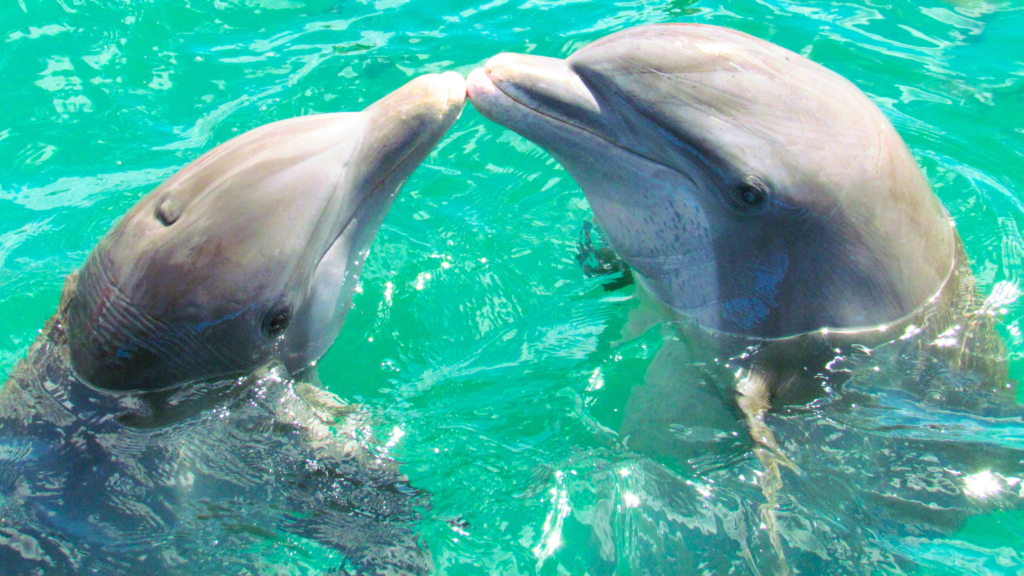
Physical contact is also communicative. Dolphins bump against each other in ways that carry distinct meanings. A gentle touch between companions reinforces social bonds. A firm bump between adult males can signal dominance or competition. Mothers and calves maintain near-constant physical contact in the early months of a calf’s life, which appears to be part of how the bond is established and maintained.
On a Dolphins and You tour along the Waianae Coast, much of what you see at the surface is this physical layer of communication. The spins, the tail slaps, the tight groupings, the way certain dolphins stay close together while others circle wider, all of it carries meaning within the pod.
The more researchers study how dolphins identify and call to each other, the more it becomes clear that their communication system shares structural features with human language. There is individual identity, long-term memory, cultural transmission, regional variation, and real-time social coordination.
Dolphins don’t just make noise. They are exchanging information with each other in ways that shape relationships, coordinate behavior, and hold communities together across decades.
That makes every sound you hear on the water something worth paying attention to.
Want to understand more about how Hawaii’s spinner dolphins think and behave?
👉Explore the Dolphin Behavior and Intelligence section of our Ultimate Guide to Dolphins in Oahu →
Dolphins and You · Oahu, Hawaii
Reading about dolphin clicks and whistles is one thing. Listening to a pod of spinner dolphins communicating in the water around your boat, off the coast of West Oahu, is something you won't forget. Join us for a morning on the water and see what their language actually sounds like in the wild.
4.9 ★
Google & TripAdvisor
35 yrs
in business
Wild
100% wild dolphins
Tours depart from the Waianae Coast, West Oahu, where Hawaii's spinner dolphins gather every morning.
